

Have you ever reviewed your investment statements and wondered if your money truly supports the causes you believe in? For many, the answer leads to values-based investing, a strategy that lets you pursue financial goals while staying true to your principles. This approach goes beyond traditional metrics, incorporating environmental, social, and governance factors into decision-making. In this post, we explore the essentials, compare key methods, and share practical ways to get started, all grounded in current trends for 2026.
Comparing Key Strategies and Understanding the Landscape
Values-based investing includes several overlapping but distinct methods. Here is a side-by-side overview to clarify how they differ in focus, implementation, and potential outcomes:
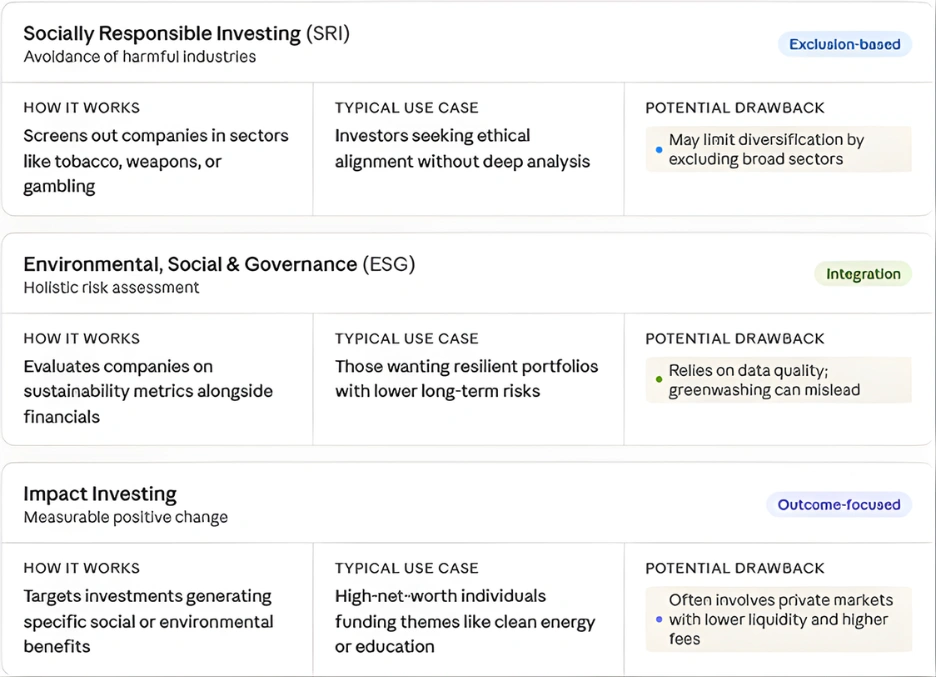
This framework helps match your priorities to the right tool. For instance, if climate action drives you, ESG might integrate well into a core portfolio, while impact strategies could suit dedicated allocations.
Trends Shaping Values-Based Investing in 2026
Industry insights point to evolving priorities. Climate adaptation remains prominent, with investors favoring companies addressing water scarcity or resilient infrastructure. Social themes like workforce diversity and fair labor gain traction amid global shifts. Governance focuses on board accountability and transparency. Research indicates these factors may correlate with stronger performance, as firms with robust practices tend to navigate challenges better, potentially reducing volatility over time.
Steps to Build Your Values-Aligned Portfolio
Ready to align your investments? Consider following these practical steps:
- Define your core values: List what matters most, such as environmental protection, human rights, or community development.
- Assess current holdings: Review your portfolio for misalignments using tools like ESG ratings from providers.
- Select vehicles: Consider opting for screened ETFs for simplicity, ESG-integrated mutual funds for balance, or impact funds for targeted change. Customization via direct indexing allows excluding specific companies while tracking indexes.
- Allocate thoughtfully: consider starting with 10-20 percent in values-based assets to maintain diversification, adjusting based on risk tolerance.
- Monitor and adjust: Track performance and impact annually, ensuring the strategy evolves with your goals.
Some of the benefits can include greater personal satisfaction and potential for competitive returns as sustainable practices can link to long-term resilience. Considerations involve possible short-term underperformance in certain markets or challenges in verifying true alignment.
Client Spotlight: Sarah’s Journey to Alignment [AG1.1]
Sarah, a professional in her mid-50s working in education, had always been passionate about sustainability. For years, she held a standard broad-market index fund that delivered reliable growth but included heavy exposure to traditional energy companies. As she learned more about climate risks and the shift toward renewables, she felt a disconnect. Her investments supported industries she believed were contributing to environmental challenges, even as she recycled at home, supported green policies, and encouraged her family to reduce their carbon footprint.
After discussing her concerns, Sarah decided to transition a portion of her portfolio to an ESG-integrated strategy. She focused on funds emphasizing renewable energy and companies with strong environmental practices, while keeping broad diversification across sectors. The change was gradual to avoid disrupting her overall risk profile. When energy markets experienced volatility in recent years, driven by policy shifts and supply dynamics, her renewable-focused holdings provided stability. Diversified green investments, including solar and wind exposure, held up better than some traditional energy plays, contributing to solid overall returns without the sharp swings she might have seen otherwise.
What mattered most to Sarah was the sense of purpose. She now reviews her statements knowing her capital supports innovation in clean energy and sustainable practices. The portfolio continues to grow in line with her retirement timeline, and she feels more engaged and committed to staying the course through market cycles.
Values-based investing bridges financial prudence with personal conviction. It empowers you to invest in a future that reflects your ideals without compromising on strategy. Consulting an advisor ensures your approach fits seamlessly into your overall plan.
Disclosure: This example is hypothetical and provided for illustrative purposes only; it does not reflect the experience of any specific client or guarantee future performance. ESG and values-based investing strategies may perform differently than broader market strategies and are subject to market risk, including the possible loss of principal.
Resources:
- https://www.morningstar.com/sustainable-investing/5-sustainable-investing-trends-watch-2026
- https://www.schroders.com/en/nordics/professional/insights/2026-sustainable-investment-outlook-7-key-trends-for-north-america-in-the-year-ahead
- https://corporatefinanceinstitute.com/resources/esg/sustainable-investing
- https://www.investopedia.com/terms/e/esg-investing.asp